
Mon - Sat 7:00 am to 7:00 pm

Porta Potties for Beaches: A Guide to Planning, Placement, and Permits
Beach events come with a set of challenges that don’t exist anywhere else. Sand shifts under weight, wind threatens to tip units over, tides can flood low-lying areas, and service trucks can’t drive across loose terrain. Every decision about where and how to set up portable restrooms at a coastal venue needs to account for conditions that change by the hour.
Prime Dumpster coordinates porta potty rentals for beach events across the country, from small beach weddings to large-scale festivals on public shorelines. This guide covers how to choose the right units, the ground conditions and distance requirements that affect placement, permitting rules for public and private beaches, and the environmental considerations that come with coastal sanitation.
Fast Facts: Porta Potties for Beaches
“Beach events are some of the most rewarding to plan, but the sanitation side requires more thought than a standard outdoor event,” the Prime Dumpster Pro said. “You’re dealing with sand, wind, water, and in many cases a coastal permit process that specifies exactly where units can go. Getting ahead of those factors is what separates a smooth event from a stressful one.”
- Ground stability: Units must sit on elevated, compacted ground or a stabilizing platform, never on loose sand
- Wind protection: Ground anchors or placement near structures helps prevent tipping in coastal gusts
- Distance from water: Most coastal jurisdictions require portable restrooms well above the high-tide line and a set distance from any waterway
- Service access: Pump trucks cannot drive on sand; units must be reachable from a paved or hard-packed surface
- ADA inclusion: Public beach events typically require at least 10% of units to be ADA-accessible
- Permits: Most public beach venues require a special event permit that includes a restroom and sanitation plan
Whether you’re planning a beach wedding, a festival on a public shoreline, or a corporate retreat on the coast, your dedicated Prime Dumpster account manager can walk you through the options and help you find the right units, placement strategy, and service schedule for your specific event.
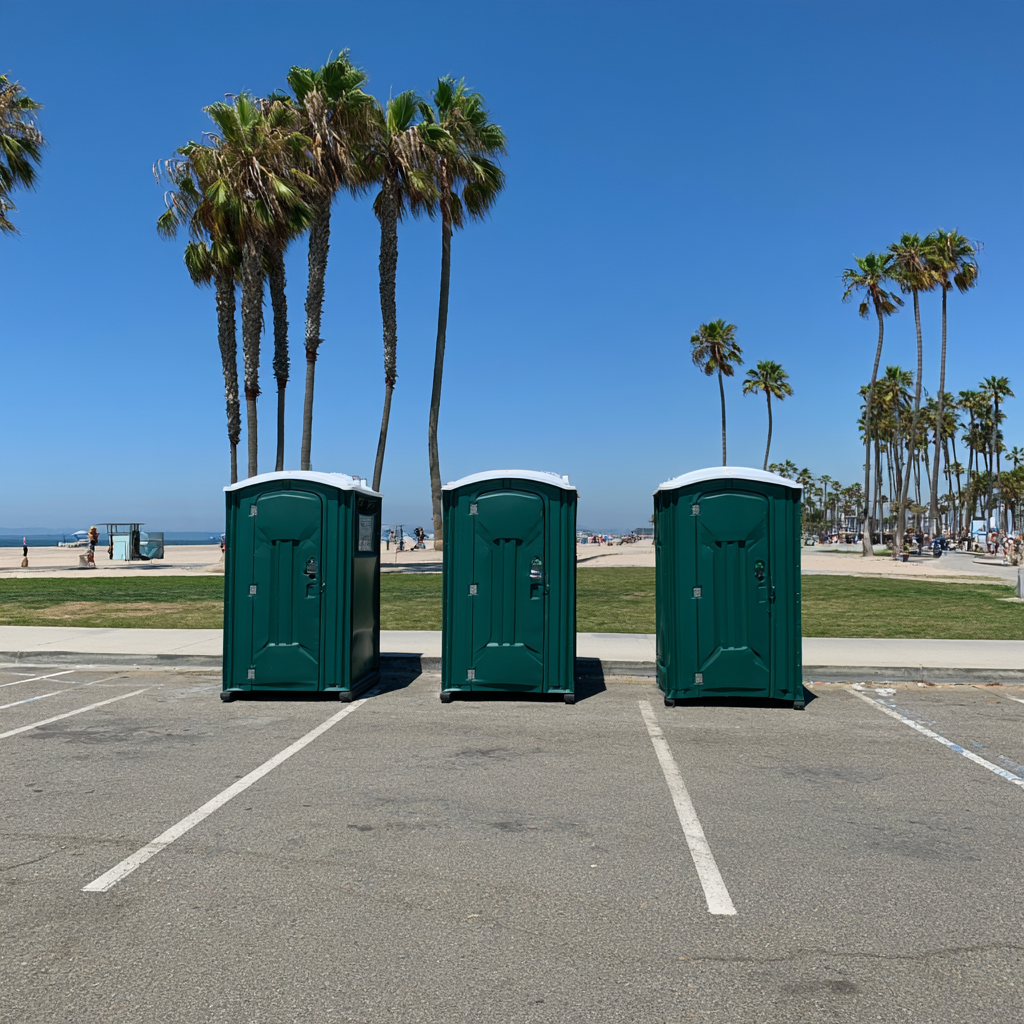
Which Unit Type Works Best for Beach Events
The best porta potty types to rent depend on the size of your event, the audience, and how long guests will be on the beach. A casual daytime cookout has different needs than an evening beach wedding with a seated dinner.
| Unit Type | What Makes It Notable | When to Use It at a Beach Event |
| Standard Porta Potty | Self-contained with toilet, urinal, and hand sanitizer. Compact and durable. | Casual beach gatherings, surf competitions, volunteer cleanups, and any event where function matters more than aesthetics. |
| Deluxe with Sink | Built-in handwashing station with soap and mirror. | Beach events with food service, where guests need to wash hands before eating. A practical middle ground between standard and luxury. |
| Deluxe Flushing | Foot-pedal flush system using fresh water. Reduced odor. | Beach weddings, corporate retreats, and upscale gatherings where guest comfort is a priority. |
| ADA-Accessible | Wider door, grab bars, interior space for wheelchair access. | Any public-facing beach event. Many permit applications require at least 10% of units to be accessible. |
| Handwashing Station | Standalone unit with freshwater tank, soap, and paper towels. | Beach events with food vendors or catering. Often required by local health codes near food handling areas. |
| Restroom Trailer | Climate-controlled, multiple stalls, running water, lighting. | Large beach weddings, VIP sections at festivals, and high-end corporate events where the restroom experience needs to match the occasion. |
Your Prime Dumpster account manager can help match the right combination of units to your event size, audience, and beach conditions. Our porta potty resource page also contains a wealth of information on types, prices, placement, and much more.
Why Beach Placement Is Different
Coastal venues introduce tidal flooding, sand instability, salt air corrosion, sustained wind exposure, and permit requirements that don’t apply to inland events.
Inland event placement is mostly about convenience, access, and aesthetics. Beach placement adds an entire layer of environmental variables that can change within a single afternoon. A spot that looks stable at low tide may be underwater four hours later. A unit that feels solid on packed sand near the parking lot may sink into softer terrain 50 yards closer to the water.
The factors that make beach placement distinct from any other outdoor setting:
- Tidal patterns that shift the usable footprint of the beach throughout the day
- Loose, uneven sand that lacks the load-bearing stability of soil, gravel, or pavement
- Sustained coastal winds that create tipping risk for freestanding structures
- Salt air and moisture that accelerate wear on equipment
- Coastal protection rules that restrict where temporary structures can be placed relative to the waterline, dunes, and protected habitat
Each of these requires a specific response in how and where units are positioned, which the following sections cover in detail.
Choosing the Right Ground and Stabilizing Units
Place portable restrooms on elevated, compacted surfaces like parking lots or boardwalk-adjacent areas, and use ground anchors to prevent wind-related tipping.
The single most important placement decision at a beach event is the surface the unit sits on. Loose sand is not a viable base. It shifts under weight, absorbs moisture unevenly, and can cause a unit to lean, settle, or tip in windy conditions.
The best placement options at most beach venues are parking lots, paved access roads, concrete pads, boardwalk-adjacent areas, and any compacted surface above the sand line. When these aren’t available or aren’t close enough to the event, a temporary platform made from plywood sheeting or a gravel pad creates a stable base on top of harder-packed sand.
Wind anchoring is the other half of the stability equation. Coastal winds are stronger and more sustained than inland gusts, and a portable restroom is a tall, flat-sided structure that catches wind easily.
- Ground stakes or screw-in anchors on at least two sides of the unit
- Placement near existing structures like fences, walls, or buildings that act as windbreaks
- Positioning with the narrow end of the unit facing the prevailing wind direction to reduce the surface area exposed to gusts
“The biggest mistake we see at beach events is placing units too close to the water on soft sand because the organizer wants them convenient for guests,” the Prime Dumpster Pro said. “Convenience matters, but a unit that sinks or tips over during the event creates a much bigger problem than a longer walk.”
How Far From the Water Should a Porta Potty Be?
Most coastal jurisdictions require portable restrooms to be placed well above the high-tide line and a minimum distance from any waterway, with exact setbacks varying by local ordinance.
There is no single federal standard for how far a portable restroom must be from the water at a beach event. Distance requirements are set by state, county, and municipal agencies and vary widely depending on the coastline, the type of waterway, and whether the event is on public or private property.
What’s consistent across most jurisdictions is the principle behind the rules: portable sanitation equipment must be positioned to prevent any possibility of waste discharge reaching surface water or groundwater. The Florida Department of Health, for example, explicitly prohibits discharge from portable restrooms into any water course, drainage ditch, canal, storm drain, lake, stream, river, estuary, or groundwater.
In practical terms, that means placing units above the high-tide line, away from dune systems, and uphill from any drainage path that leads toward the water. If your beach venue has a specific setback distance in its permit guidelines, that number governs. If it doesn’t, position units as far from the waterline as your site plan allows while keeping them accessible to guests and reachable by the service truck.
Service Truck Access on Sand and Soft Terrain
Porta potties at beach events must be positioned where a service truck can reach them on a paved or compacted surface, since pump trucks cannot operate on loose sand.
Service logistics are one of the most overlooked parts of beach event planning. A portable restroom needs to be pumped, cleaned, and restocked on a regular schedule, and the trucks that do that work are heavy vehicles that cannot drive across loose sand.
If units are placed where a truck can’t reach them, servicing either doesn’t happen on schedule or requires the unit to be relocated mid-event. Both outcomes create problems for the organizer and the guests.
“We always ask event planners to walk the route from the nearest paved road to the planned unit location before confirming placement,” the Prime Dumpster Pro said. “If a full-size truck can’t get there without driving on sand, we need to find a different spot.”
Plan unit placement by starting from the access point and working toward the event, not the other way around. Identify the closest paved or compacted surface that a service vehicle can use, then position units within reach of that path. This approach anchors the placement in logistics first and adjusts for guest convenience second.
Permits for Beach Events
Most public beach events require a special event permit that includes a site plan showing the number, type, and location of portable restrooms.
If your event is on a public beach, a park, or any government-managed shoreline, expect a permit process. Most jurisdictions require event organizers to submit a site plan that specifies portable restroom placement as part of the application. California State Parks, for example, notes that portable restrooms may be required at the permittee’s expense, with locations determined in consultation with park management.
Permit applications for beach events typically require:
- Total expected attendance and event duration
- Number of portable restrooms, including ADA-accessible units
- A site plan showing the exact placement of each unit
- Proof of a service contract with a licensed portable sanitation provider
- A waste management and removal plan
- Proof of insurance covering the event and temporary structures
Submit your permit application early. Many jurisdictions require 30 days or more of lead time, and larger events may need six to nine months. Your rental provider can often help with the restroom section of the application based on your attendance estimate and site layout.
Private beach properties may have fewer permitting requirements, but coastal setback rules and environmental protections typically still apply regardless of property ownership.
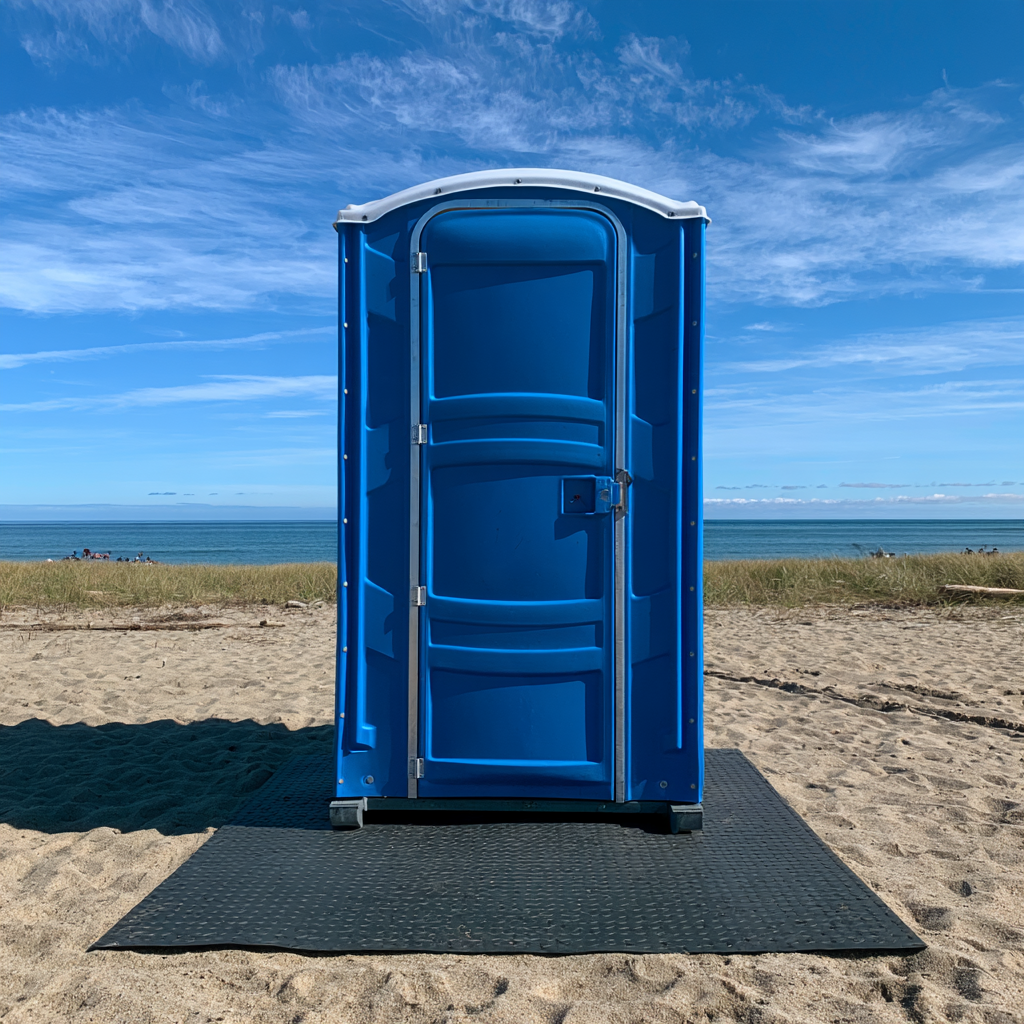
Keeping Beach Porta Potties Clean and Hygienic
Beach conditions accelerate the need for cleaning and maintenance, making a proactive hygiene plan essential for any coastal event.
Sand, salt air, and higher heat all take a toll on portable restrooms faster than typical inland conditions. Units at beach events tend to need more frequent servicing than the same units at a park or parking lot event of the same size.
For events lasting more than a few hours, schedule mid-event service checks in addition to the standard pre-event setup. Stock extra supplies, as sand and moisture increase the rate at which toilet paper and hand sanitizer are used. Handwashing stations near food service areas should be checked and restocked throughout the event.
Our full guide to porta potty hygiene tips for beaches covers cleaning schedules, supply management, and practical steps for keeping units sanitary in coastal conditions.
Protecting the Coastal Environment
Responsible beach event sanitation includes full waste containment, placement away from protected habitat, and prompt removal of all equipment after the event.
Beaches are environmentally sensitive areas, and portable sanitation at coastal events carries a responsibility that goes beyond guest comfort. Every unit placed on or near a beach must be fully contained, properly serviced, and removed promptly once the event ends.
The core environmental principles for porta potties at beaches are straightforward. No waste discharge of any kind should reach the ground surface, sand, or water. Units should be placed away from dunes, nesting areas, and any protected coastal habitat. All equipment, including anchoring hardware and platform materials, should be removed within 24 hours after the event concludes.
Working with a rental provider that has experience with coastal events helps ensure that waste handling, service scheduling, and removal timelines all meet the standards your permit and local regulations require.
Your Guide to Porta Potties for Beaches
Planning porta potties for beaches takes more thought than a typical outdoor event, but the fundamentals are manageable once you understand the terrain, the regulations, and the logistics. Stable ground, wind protection, service truck access, proper distance from the water, and a solid permit application cover the essentials.
Contact our team at Prime Dumpster for help planning portable restroom setup for your next beach event. We’ll help you select the right units, confirm placement with your site conditions, and coordinate delivery and servicing on a schedule that fits your event timeline.
If you are looking for Summer Camp Porta Potty Rental, Click Here
Recent Posts


Follow Us
Have any questions?
+1 844 853 3867
Give us a call today so we can help you find the right waste & sanitation solution for
your project!
Contact Us