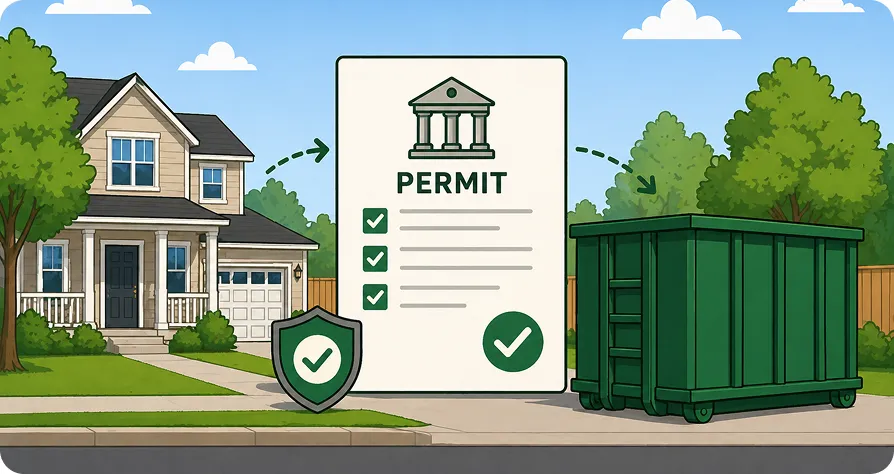
On your own driveway, parking lot or fenced work area, a container needs no city permit in Manhattan. That is the clean case and it is where most containers sit.
City property is where Manhattan is detailed, and it splits into two routes.
In the Aggieville business district and the downtown business district, a container may go in a street or alley only with a city dumpster permit. The fee is $75.00, renewal is $75.00, and anyone who places a container before getting the permit pays double the fee when it is finally issued. The fee is not refundable. The city engineer issues it on a complete application with a site plan, a finding that there is no practical alternative to the street location, and a finding that traffic and pedestrian safety can be maintained. No permit or renewal may run longer than 60 days, and when it expires the container has to come off immediately.
Outside those two districts there is no permit, but there is a test. A container may sit in a street or alley only where there is no practical alternative, and the city defines that tightly: the parcel must lack adequate space, the use must be necessary for a temporary activity on that parcel, and the code says expressly that mere inconvenience or protecting grass or landscaping does not count. If there is a dispute, the city engineer's opinion decides it.
Any container on a city street or alley, in either case, has to meet a set of physical requirements. It must not block a sidewalk. It must sit on runners if it is on asphalt. It must be immediately next to the parcel it serves. It must be clearly labeled with the owner's name and current phone number. And it must carry reflective tape at least one inch wide in a red and white pattern, a minimum of 20 square inches on each perpendicular edge, mounted at least 30 inches above the bottom of the container, on both ends and all four corners. Prime Dumpster meets that marking standard as a matter of course.
The limit most people miss is the annual one. Unless a permit says otherwise, a container may not sit in the street or alley next to the parcel it serves for more than 60 days of any calendar year. That is a budget at the address, not per rental, so a property that already had a street container this year has less left. The penalty for placing one unlawfully starts at a hundred dollars a day and rises from there.
There is also a definitional wrinkle in the code that is worth raising with us first. The city's dumpster article defines a dumpster as a container for refuse, trash, garbage, solid waste and construction materials that is emptied by a city-licensed refuse collector, while the licensing chapter itself is keyed to a narrower word that leaves building-operations waste out. Your account manager confirms with the City how that lands on your specific job before anything is scheduled, so nobody has to work it out on the day. Manhattan City Hall is at 1101 Poyntz Avenue and the city engineer's office is the one that decides a street placement. Riley County publishes its solid waste policies, rates and plan but we found no county hauler requirement listed, and because that is an index read rather than a page devoted to the question we make no claim either way about a county step.