
Mon - Sat 7:00 am to 7:00 pm

Dumpster Rental for Casino Renovation and Facilities Work in Las Vegas
Las Vegas casino properties operate at a scale and intensity that creates waste management demands unlike almost any other commercial environment. Round-the-clock operations, high-volume renovation cycles, and complex back-of-house logistics all shape how roll-off container service needs to be arranged and managed. Standard dumpster rental approaches rarely translate without adjustment to a casino environment.
Prime Dumpster coordinates roll-off container rentals for hospitality and gaming properties across the Las Vegas valley, including renovation projects, facilities maintenance, and large-scale construction work. We put together this guide to walk casino facilities managers and contractors through what dumpster rental for casino renovation in Las Vegas actually requires.
Fast Facts: Dumpster Sizes for Las Vegas Casino Projects
Dumpster size affects both debris capacity and placement logistics on casino properties. Here’s a look at standard roll-off sizes, dimensions, and common uses across gaming and hospitality project types.
| Size | Approximate Dimensions | Common Casino Uses |
| 10-Yard Dumpster | 12′ × 8′ × 3.5′ | Concrete removal, small back-of-house cleanouts, heavy debris |
| 15-Yard Dumpster | 16′ × 7.5′ × 4.5′ | Single-room renovation debris, kitchen equipment removal |
| 20-Yard Dumpster | 22′ × 7.5′ × 4.5′ | FF&E removal, multi-room renovation, flooring and fixture debris |
| 30-Yard Dumpster | 22′ × 8′ × 6′ | Large renovation phases, structural demolition, high-volume construction |
| 40-Yard Dumpster | 22–24′ × 8′ × 8′ | Full floor renovations, major demolition, sustained construction output |
Dimensions are approximate and may vary by provider. Pricing and availability vary based on project scope, debris type, weight, rental duration, and placement location across the Las Vegas valley.
Ready to get started? Contact our team for custom solutions if you’re looking to rent a dumpster in Las Vegas.
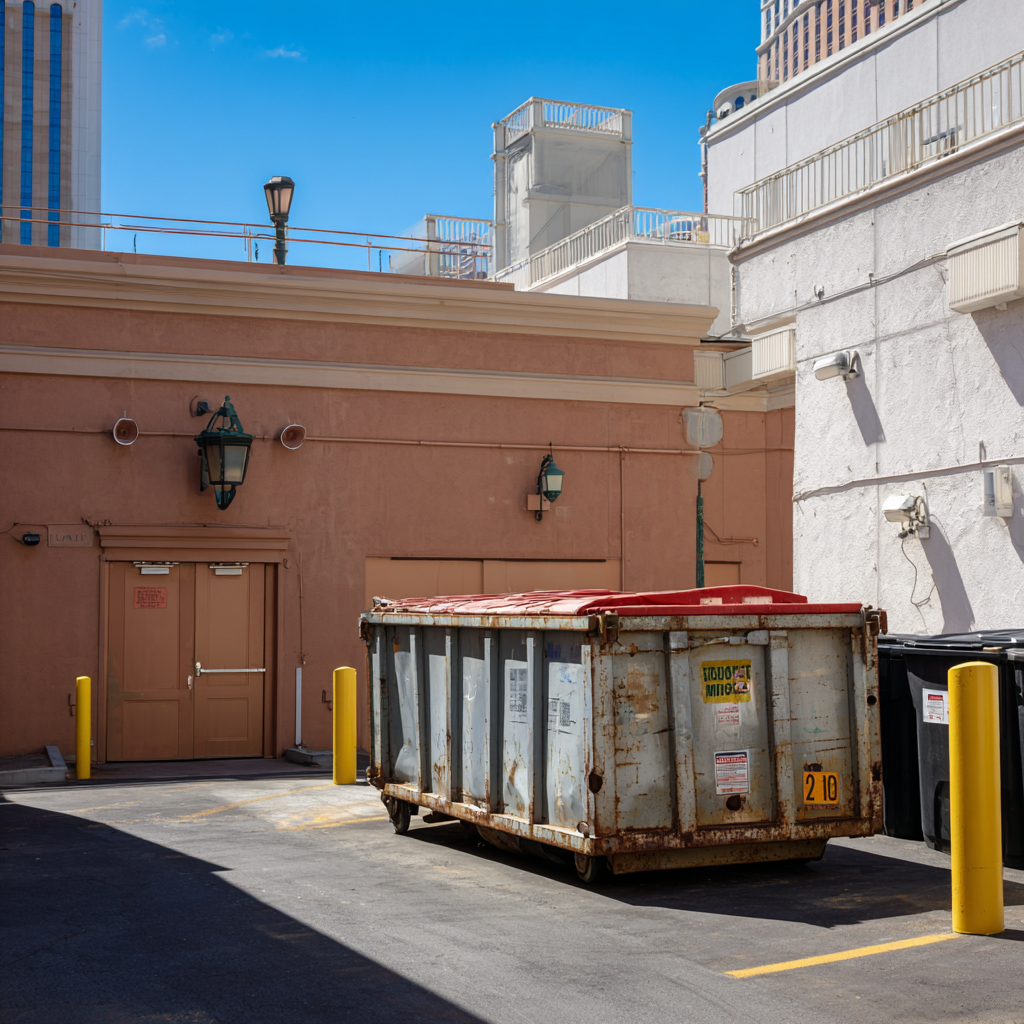
Why Casino Properties Need Roll-Off Dumpsters
Casino properties generate waste across a wider range of project types than most commercial facilities. Renovation cycles run continuously as properties refresh gaming floors, hotel rooms, restaurants, and entertainment venues to stay competitive. Each phase produces concentrated volumes of debris that standard trash service cannot accommodate.
FF&E removal is one of the most common drivers of roll-off container use on gaming properties. Replacing slot machines, gaming tables, seating, lighting, and interior fixtures across even a single floor generates substantial volume in a short window. A 20-yard dumpster handles most single-zone FF&E removal scopes, with larger containers or rotation schedules needed for full floor or multi-area replacements.
Back-of-house operations also generate periodic cleanout needs that require temporary container service. Kitchen equipment replacement, storage area purges, and maintenance shop cleanouts all produce debris volumes that fall outside the scope of routine waste pickup. Coordinating container delivery and pickup around shift schedules in active back-of-house environments requires the same advance planning as any other casino project.
Casino Renovation: Managing Waste in an Active Environment
Dumpster rental for casino renovation in Las Vegas involves a set of logistical constraints that don’t exist on standard commercial job sites. Most casino renovations happen in phases within operating properties, which means debris removal has to proceed without disrupting guests, gaming operations, or the property’s continuous revenue flow.
Phased demolition creates a specific debris management challenge. Work zones shift as phases progress, and container placement that works during one phase may become inaccessible or disruptive during the next. Building container location changes into the renovation schedule from the start — rather than adjusting reactively — keeps waste removal aligned with active work without creating conflicts on the property floor.
Compressed renovation timelines add another layer of complexity. Casino properties often schedule renovation work during lower-occupancy windows, which means debris output is concentrated into shorter periods than the project scale might otherwise suggest. Sizing containers for peak output during those windows, rather than average daily volume, prevents mid-phase capacity problems that stall work during the limited time available.
Container rotation scheduling on large renovation projects keeps debris from accumulating between pickups. A 30 or 40-yard dumpster on a planned swap schedule handles most large-phase casino renovation scopes without requiring reactive last-minute arrangements when containers fill unexpectedly.
Placement Considerations on Casino Properties
Placement is the most complex part of arranging roll-off container service on a gaming property. Casino sites are dense environments where every access point, driveway, and staging area serves multiple operational functions simultaneously.
Loading dock coordination is typically the first placement conversation. Most casino properties route all large deliveries and pickups through a managed loading dock schedule, and roll-off containers are no exception. Coordinating container delivery and pickup windows with the property’s dock manager before booking ensures the container arrives when the site can actually receive it.
Valet lanes, emergency vehicle access routes, and fire marshal-required clearances all restrict where containers can sit on the property exterior. These aren’t optional considerations — placing a container in a fire lane or blocking an emergency access route creates compliance issues that result in immediate removal regardless of project timeline.
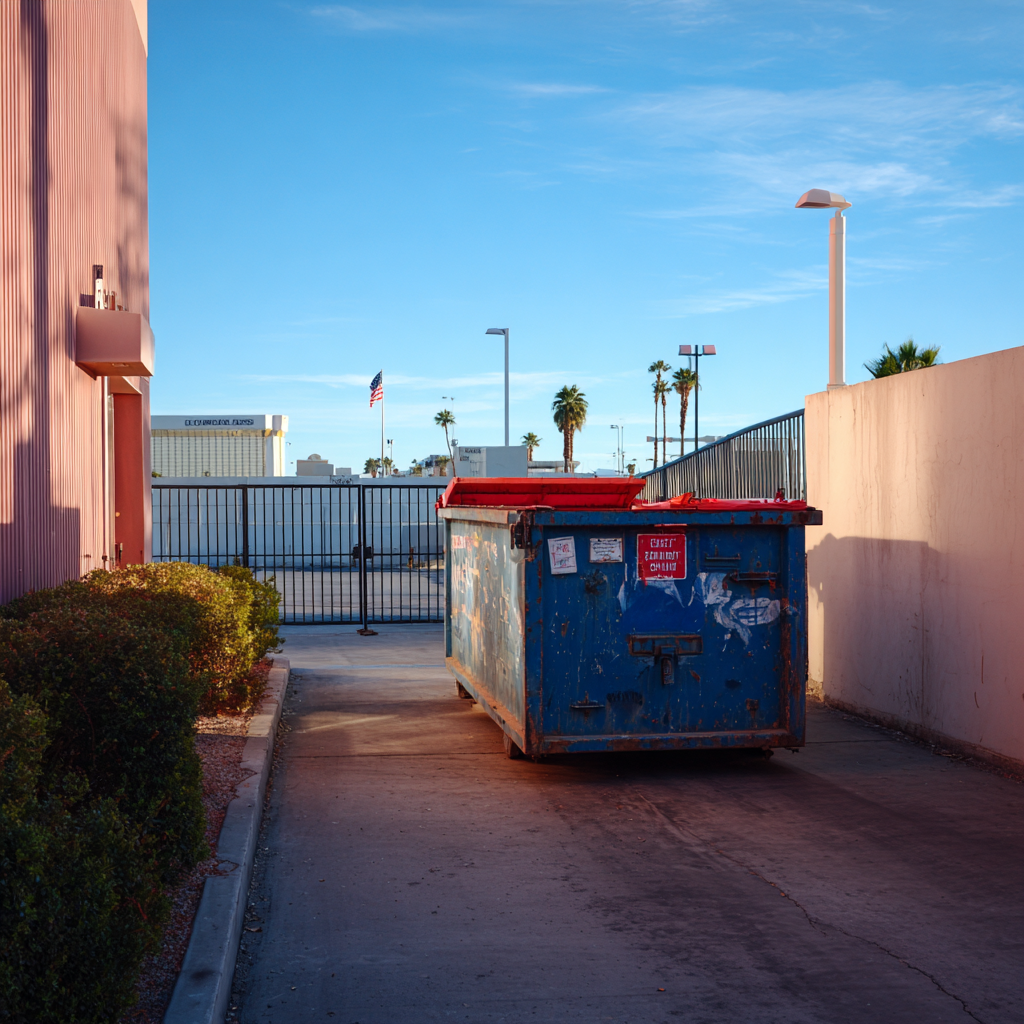
Back-of-house staging areas are the most practical placement option on most casino properties. They keep containers out of guest sight lines, reduce conflicts with front-of-house operations, and typically offer the truck clearance needed for safe delivery and pickup. Identifying viable back-of-house staging zones during the project planning phase, rather than on delivery day, prevents placement problems that delay the start of work.
Outdoor venue and pool deck areas require additional coordination when renovation work affects those spaces. Access routes to those areas often pass through active guest zones, which means delivery timing needs to account for guest activity patterns across different times of day.
Permits and Compliance in Las Vegas
Most casino properties sit on large private parcels, which simplifies the permit question considerably. Containers placed entirely on private commercial property, such as a private parking lot or staging area, generally do not require a city permit in Las Vegas, Henderson, or Clark County.
Jurisdiction is the first thing to establish for any casino project. Large-scale hospitality and gaming projects on the Strip fall under Clark County jurisdiction and involve additional gaming commission and fire marshal reviews. Properties located within the City of Las Vegas or the City of Henderson fall under those municipalities’ own permitting processes. Confirming jurisdiction before starting any permit research prevents applying to the wrong agency.
For any placement that affects the public right-of-way in unincorporated Clark County, an encroachment permit from the Clark County Public Works Department is typically required. This applies to containers that extend onto sidewalks, streets, or any public right-of-way adjacent to the property.
Most casino renovation work avoids this requirement entirely through back-of-house and private lot placement, but Strip-adjacent infrastructure projects may encounter it. Confirming placement boundaries with the property’s facilities team and the relevant jurisdiction before booking eliminates ambiguity on compliance.
Frequently Asked Questions
We asked our Pros for their expert opinions on renting and using dumpsters in gaming environments.
How does a casino’s 24/7 operation affect container scheduling?
“Most casino renovation work happens during off-peak hours, late night into early morning, which means container deliveries and pickups need to align with those windows rather than standard business hours. Scheduling that in advance with your provider is essential.”
“Properties that can’t accommodate daytime deliveries near active guest areas need a provider flexible enough to work within those restrictions consistently. That conversation should happen before the first container is booked, not after a delivery misses the window.”
How do we keep containers out of guest sight lines during a renovation?
“Back-of-house placement solves most of this. When that isn’t possible, temporary screening around the container keeps it out of the guest experience without affecting debris loading or pickup access.”
“The bigger issue is delivery and pickup timing. A roll-off truck maneuvering through a valet area during peak check-in hours creates more visibility than the container itself. Early morning windows typically offer the cleanest solution.”
What’s the best approach for managing container rotation on a large multi-phase renovation?
“Map out the debris output by phase before the project starts. Each phase has a different volume and debris type, and the container size that works for FF&E removal isn’t necessarily right for structural demolition a week later.”
“Building a rotation schedule around those phases rather than reacting when containers fill keeps the project moving and prevents the delays that come with waiting for an emergency pickup mid-renovation.”
Can a single container handle multiple debris types across a casino renovation?
“General construction debris, like drywall, framing, flooring, fixtures, can all go into the same container. The exception is concrete, masonry, or any heavy structural material, which needs a dedicated 10-yard unit regardless of the overall project size.”
“Mixing heavy materials into a larger container doesn’t increase the weight allowance. It just means hitting the weight limit before the container is visually full, which results in overage fees that could have been avoided with a dedicated unit from the start.”
Coordinate Your Las Vegas Casino Dumpster Rental Early
Casino renovation and facilities projects require more lead time and coordination than standard commercial rentals. Placement logistics, dock scheduling, permit jurisdiction, and phase-by-phase container planning all need to be sorted before the first delivery. Contact our team to coordinate roll-off container service for your Las Vegas gaming or hospitality project.
If you are looking for Q&A with the Prime Dumpster Pros: Dumpster Rental in Las Vegas, Click Here
Recent Posts


Follow Us
Have any questions?
+1 844 853 3867
Give us a call today so we can help you find the right waste & sanitation solution for
your project!
Contact Us