
Mon - Sat 7:00 am to 7:00 pm

Prime Dumpster Quick Guide: Dumpster Rental for Houston Oil and Gas Industry Projects
Houston sits at the center of the U.S. oil and gas industry. Refineries, petrochemical plants, and energy corridor facilities generate substantial volumes of non-hazardous waste during maintenance cycles, turnarounds, and ongoing construction. Managing that waste efficiently requires container logistics built around industrial realities, not standard residential or commercial timelines.
Prime Dumpster coordinates dumpster rental for Houston oil and gas industry projects of all sizes and types. We put together this guide to walk through what facility managers, contractors, and project coordinators need to know before arranging roll-off container service for industrial work.
Fast Facts: Dumpster Rental for Oil and Gas Projects
Roll-off containers for industrial work come in five standard sizes. Here’s a look at approximate dimensions and types you’re likely to find when renting a dumpster in Houston for oil and gas projects.
| Size | Approximate Dimensions | Common Oil and Gas Uses |
| 10-Yard Dumpster | 12′ × 8′ × 3.5′ | Concrete removal, small maintenance debris, heavy scrap |
| 15-Yard Dumpster | 16′ × 7.5′ × 4.5′ | Insulation removal, pipe packaging, general facility waste |
| 20-Yard Dumpster | 22′ × 7.5′ × 4.5′ | Mixed construction debris, equipment packaging, fit-out waste |
| 30-Yard Dumpster | 22′ × 8′ × 6′ | Turnaround debris, structural materials, large maintenance scopes |
| 40-Yard Dumpster | 22–24′ × 8′ × 8′ | High-volume shutdowns, major demolition, sustained construction output |
Container dimensions are approximate and may vary. Availability and pricing vary based on project location, debris type, weight, and rental duration.
Let’s Ask the Prime Dumpster Pro!
“Industrial sites along the Houston Ship Channel and Energy Corridor have placement constraints that don’t come up on standard job sites,” says the Prime Dumpster Pro. “Getting container placement approved through the facility’s safety and logistics team before delivery day is the single most important step in keeping a roll-off rental from becoming a project delay.”
Turnaround and Shutdown Projects
Turnarounds compress a large volume of debris output into a short window. Insulation removal, scaffolding waste, pipe materials, and general facility debris all accumulate faster than a single container can accommodate without planned rotation.
Coordinating a container rotation schedule before the turnaround begins keeps waste removal from becoming a bottleneck during critical phases. Sizing up to a 30 or 40-yard unit with scheduled swaps handles most large-scale shutdown scopes without requiring reactive last-minute arrangements mid-project.
Refinery and Petrochemical Facility Maintenance
Ongoing maintenance at refinery and petrochemical facilities generates a steady stream of non-hazardous debris between major shutdowns. Insulation, metal scrap packaging, general construction materials, and facility waste accumulate on maintenance schedules rather than project timelines.
Scheduled container rotation aligned to maintenance windows works better than one-off rentals arranged reactively. Facility managers who establish rotation agreements in advance spend less time coordinating waste removal and maintain cleaner lay-down areas throughout the maintenance cycle.
Pipeline and Infrastructure Projects
Pipeline construction and right-of-way work in the Houston region spans a wide range of site conditions. Some corridors run through active industrial zones while others cross semi-remote areas where access for delivery trucks requires advance scouting.
Confirming truck access and identifying stable ground for container placement before scheduling delivery prevents failed drop-offs. On longer pipeline corridors, positioning containers at active work zones rather than a single central location reduces haul distances and keeps debris from accumulating across the right-of-way.
What Can and Can’t Go in a Roll-Off Dumpster on an Oil and Gas Site
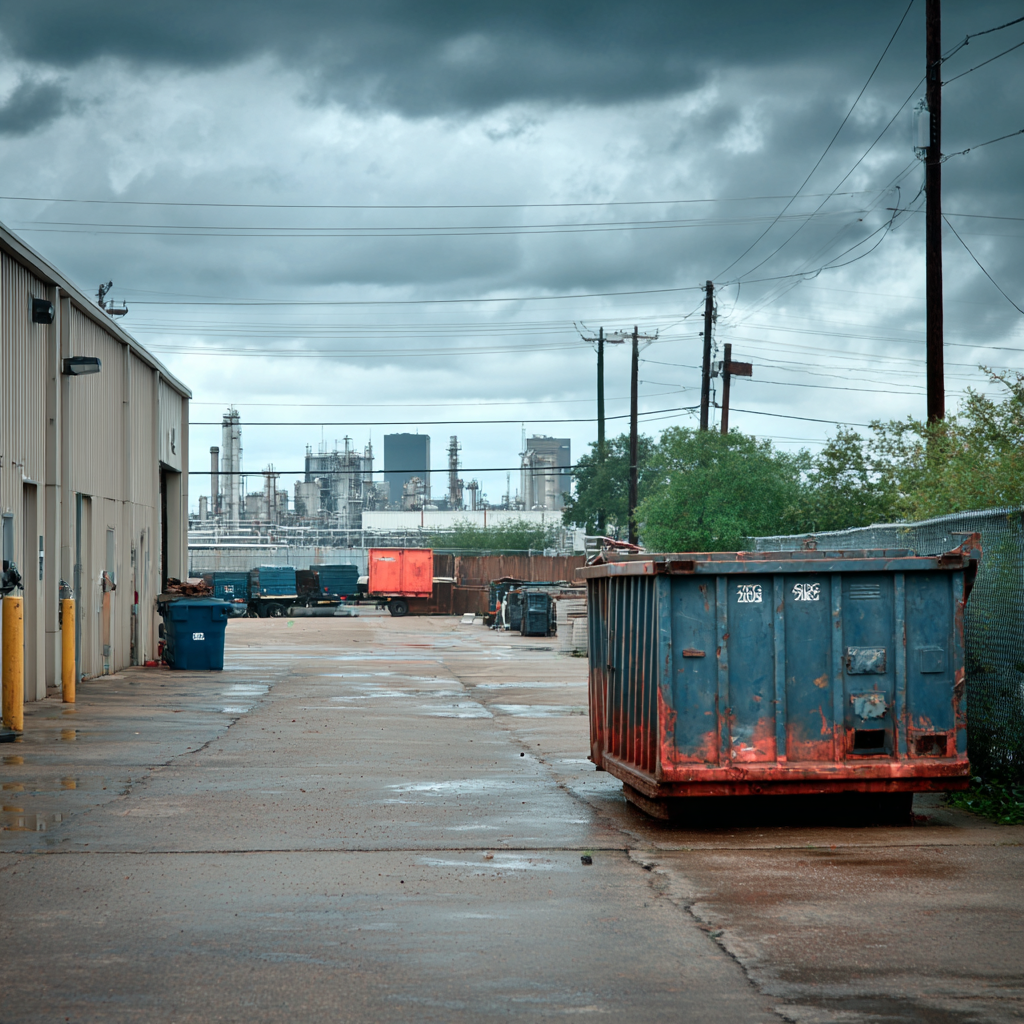
Standard roll-off containers on industrial sites accept non-hazardous construction and maintenance debris. That includes insulation, lumber, drywall, metal packaging, concrete, and general facility waste generated during maintenance or construction activity.
Regulated materials require separate disposal entirely outside of a standard rental. Liquid waste, chemical containers, hydrocarbon-contaminated materials, asbestos, and any substance classified as hazardous under federal or Texas state guidelines cannot enter a roll-off container. Identifying and segregating those materials before container delivery is a required step on any compliant industrial job site.
Learn more about Houston dumpster placement for petrochemical settings, plus construction sites, homes, and other locations around town.

Frequently Asked Questions
We asked the Prime Dumpster Pros the questions that come up most often on oil and gas rental jobs in the Houston area.
Do industrial facilities in Houston require special permits for roll-off containers?
“Permit requirements depend on placement. Containers positioned within a private facility’s boundaries typically don’t require a city permit. If the container needs to go on a public street or right-of-way adjacent to the facility, a Houston right-of-way permit is required before delivery.”
“Some facilities also have internal approval processes for any equipment brought onto the site. Coordinating with the facility’s safety or operations team during the planning phase identifies those requirements before they become a delivery-day problem.”
How do I size containers for a turnaround with multiple debris types?
“The general approach is to dedicate a 10-yard unit to any concrete or heavy masonry work and use a larger container on rotation for everything else. Mixing heavy materials into a 30 or 40-yard container leads to overweight fees before the container is visually full.”
“For larger turnarounds, multiple containers staged at different work zones reduce haul distances and keep debris from piling up across the site between scheduled swaps.”
How far in advance should I arrange container service for a major shutdown?
“For a large turnaround, three to four weeks of lead time is the minimum. Shutdown periods create surges in container demand across the Houston industrial corridor, and availability tightens quickly once multiple facilities schedule work in the same window.”
“Booking early also gives enough time to work through facility access approvals, confirm placement zones with the safety team, and build a rotation schedule around the project phases rather than improvising once work is underway.”
Can containers be placed directly in active lay-down areas?
“It depends on the facility’s layout and what else is staged in that zone. Lay-down areas work well for container placement when there’s enough clearance for the delivery truck to maneuver and the container doesn’t block equipment access routes.”
“Confirm that clearance with the site logistics team before scheduling. A container placed without accounting for crane swing radius or vehicle traffic patterns creates operational conflicts that are much harder to resolve after the fact.”
Plan Your Houston Oil and Gas Dumpster Rental in Advance
Industrial waste management runs smoothly when container logistics are treated as part of the project plan rather than an afterthought. From turnaround scheduling to placement approvals and debris segregation, the details that matter most are the ones confirmed before the first container arrives on site. Contact our team to facilitate dumpster rental in Houston for oil and gas projects that meet your needs and budget.
If you are looking for Dumpster Rental Placement in Houston, TX: What You Need to Know, Click Here
Recent Posts


Follow Us
Have any questions?
+1 844 853 3867
Give us a call today so we can help you find the right waste & sanitation solution for
your project!
Contact Us