Mon - Sat 7:00 am to 7:00 pm
Perfect For:
Starting At: Contact Us For Best Price
*Specifications and exact dimensions may vary slightly based on model and location
Request a Quote NowREQUEST A QUOTE
UNLOCK THE BEST DEALS FOR YOUR DUMPSTER AND PORTA POTTY RENTAL NEEDS!
Mon - Sat 7:00 am to 7:00 pm
Home Areas We Service Arizona Porta Potty Rental Buckeye, Arizona 85326
Find Sustainable Porta Potty
in Buckeye
Prime Dumpster supplies porta potty rentals across Buckeye, Arizona, and the work here is dominated by new construction. Buckeye is one of the fastest-growing cities in the country, so most orders come from subdivision build-outs, offsite road and utility work, and the solar and logistics projects out toward the Palo Verde corridor, alongside community events at the parks and sports complexes. Almost none of that ground has plumbing on it yet. We arrange the units and the service schedule through vetted local partners, and your account manager owns the order end to end.
What you pay depends on the rental term, the number of units, the service visit count and the travel to your site. Below you will find how Buckeye's eight-class street permit system works, what the county requires on a crew, and what desert placement and servicing actually involve.
Term is the main driver, and Buckeye's building pattern plays to it. A subdivision phase that runs eighteen months is quoted per week at a far better rate than a one-week booking, and the unit count can step up and down as phases open.
Distance is the Buckeye reality. The city covers an enormous area, and a site out past Verrado or down toward the Interstate 10 interchanges is a long run from the nearest yard. Give your account manager a cross street or a parcel reference, not just "Buckeye".
Service frequency should be set by use, not habit. A ten-person framing crew is a weekly unit. A hundred-worker solar site in July is not. Heat here is severe and sustained, and the tank works harder for it.
Unit type closes it out. Standard units cover crews. Solar units earn their cost on unlit sites where work starts before dawn in summer, which is common on Buckeye construction.
Looking for a dependable porta potty rental solution? Contact us today for a free quote! We're here to provide you with a straightforward and competitive estimate for all your porta potty rental needs. Find out how easy sanitation can be with Prime Porta Potty.
Received your quote and ready to proceed? We make choosing your porta potty rental simple and efficient. Contact us to select the best options for your needs and we'll take care of the rest.
Scheduling your porta potty delivery is a breeze. Just tell us when and where you need it, and we’ll handle the rest. Prime Porta Potty is all about quick and reliable service, getting the right unit to your site when you need it.
Done with your event or need your porta potty serviced? Just give us a call to arrange a fast and convenient pickup. We’re ready to quickly remove or service your unit and make your experience hassle-free.
The prices below reflect average ranges for a standard five-day rental period. Your account manager will confirm tonnage, overage rates, and other project specifics during your free, custom quote.
| Unit Type | Average Price Range | Best For |
|---|---|---|
| Standard Porta Potty | $199–$349 | Construction sites, small events, backyard projects |
| ADA-Compliant Porta Potty | $200–$300 | Public events and job sites that need an accessible unit |
| Deluxe Flushing Porta Potty | $300–$400 | Weddings, parties, and guest-facing events |
| Deluxe Porta Potty with Sink | $300–$400 | Events where guests need a sink inside the unit |
| Solar Porta Potty | $500–$600 | Remote sites and off-grid events |
| Handwashing Station | $150–$250 | Food areas, job sites, and events |
| Restroom Trailer | From $1,500 | Weddings, corporate events, and long-term sites |
Perfect For:
Starting At: Contact Us For Best Price
*Specifications and exact dimensions may vary slightly based on model and location
Request a Quote Now
Perfect For:
Starting At: Contact Us For Best Price
*Specifications and exact dimensions may vary slightly based on model and location
Request a Quote Now
Perfect For:
Starting At: Contact Us For Best Price
*Specifications and exact dimensions may vary slightly based on model and location
Request a Quote Now
Perfect For:
Starting At: Contact Us For Best Price
*Specifications and exact dimensions may vary slightly based on model and location
Request a Quote Now
Perfect For:
Starting At: Contact Us For Best Price
*Specifications and exact dimensions may vary slightly based on model and location
Request a Quote Now
Perfect For:
Starting At: Contact Us For Best Price
*Specifications and exact dimensions may vary slightly based on model and location
Request a Quote Now
Perfect For:
Starting At: Contact Us For Best Price
*Specifications and exact dimensions may vary slightly based on model and location
Request a Quote Now
Perfect For:
Starting At: Contact Us For Best Price
*Specifications and exact dimensions may vary slightly based on model and location
Request a Quote Now
Perfect For:
Starting At: Contact Us For Best Price
*Specifications and exact dimensions may vary slightly based on model and location
Request a Quote NowBuckeye's construction answer comes from Maricopa County, and it is stricter than the federal one. The county's health code requires sanitary toilets at a ratio of at least one per 20 people on any construction, erection, alteration, repair or demolition project. The toilets must be of a water-flushed or chemical type the county approves, and they must sit on or within 200 feet of each work area. Crucially, the duty bites before work proceeds rather than once the crew is on site, so a unit is a start-up item on a Buckeye job, not an afterthought.
Set that against the federal worker-safety table, which the Arizona Division of Occupational Safety and Health enforces here after adopting the federal standards by reference. The federal table runs one facility for up to 20 workers, one toilet seat and one urinal per 40 above that, and one per 50 once a site passes 200 workers. On a 60-person Buckeye crew the federal table asks for two and the county asks for three, so the county figure is the one to build to. The federal handwashing rule applies on every site in every state, with an exception only for mobile crews with ready transport to nearby facilities.
For events, no Buckeye ratio is published, so the county minimum governs: one toilet per 100 people in attendance at a public gathering for a commercial, religious or public event where permanent facilities on the premises are not adequate, placed within 200 feet, or as the county health officer requires. Existing off-site restrooms can count only with the owner's written permission, free public access throughout, and signs showing the way.
For a smaller private function, work from one unit per 50 guests over about four hours and add 15 to 20 percent where alcohol is served. The porta potty calculator does the arithmetic, and your account manager will check it against the venue's own restrooms.
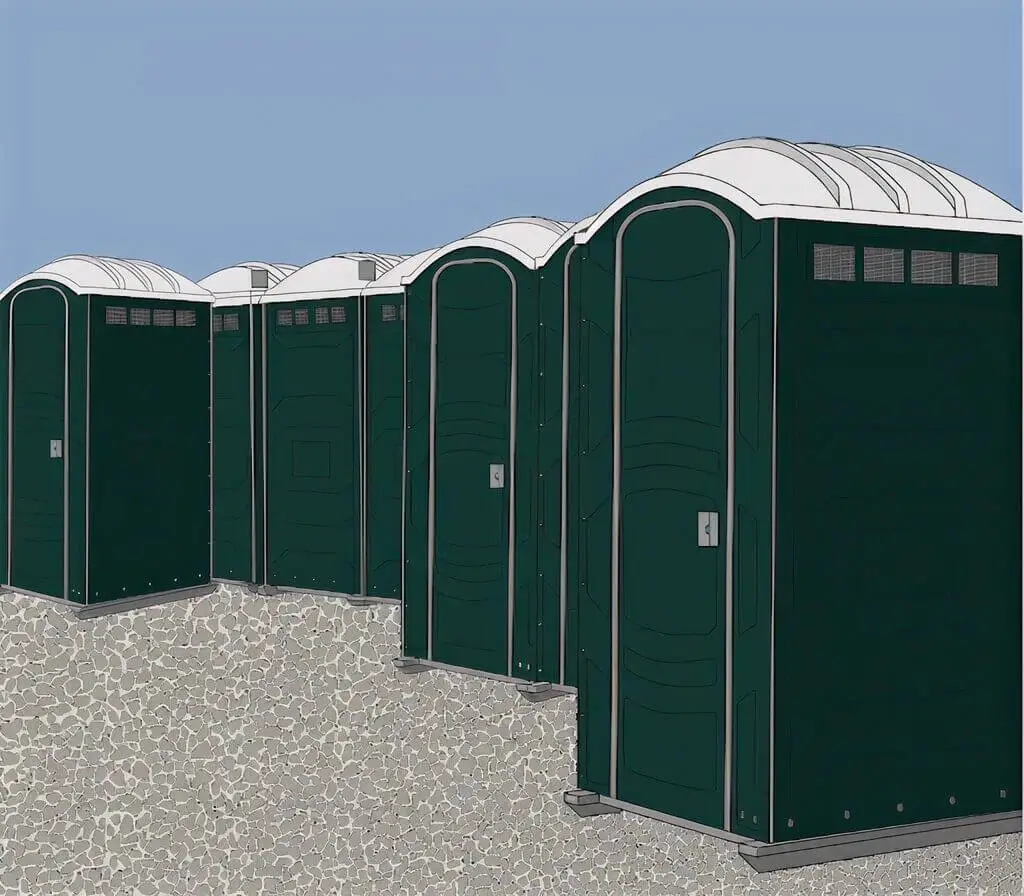
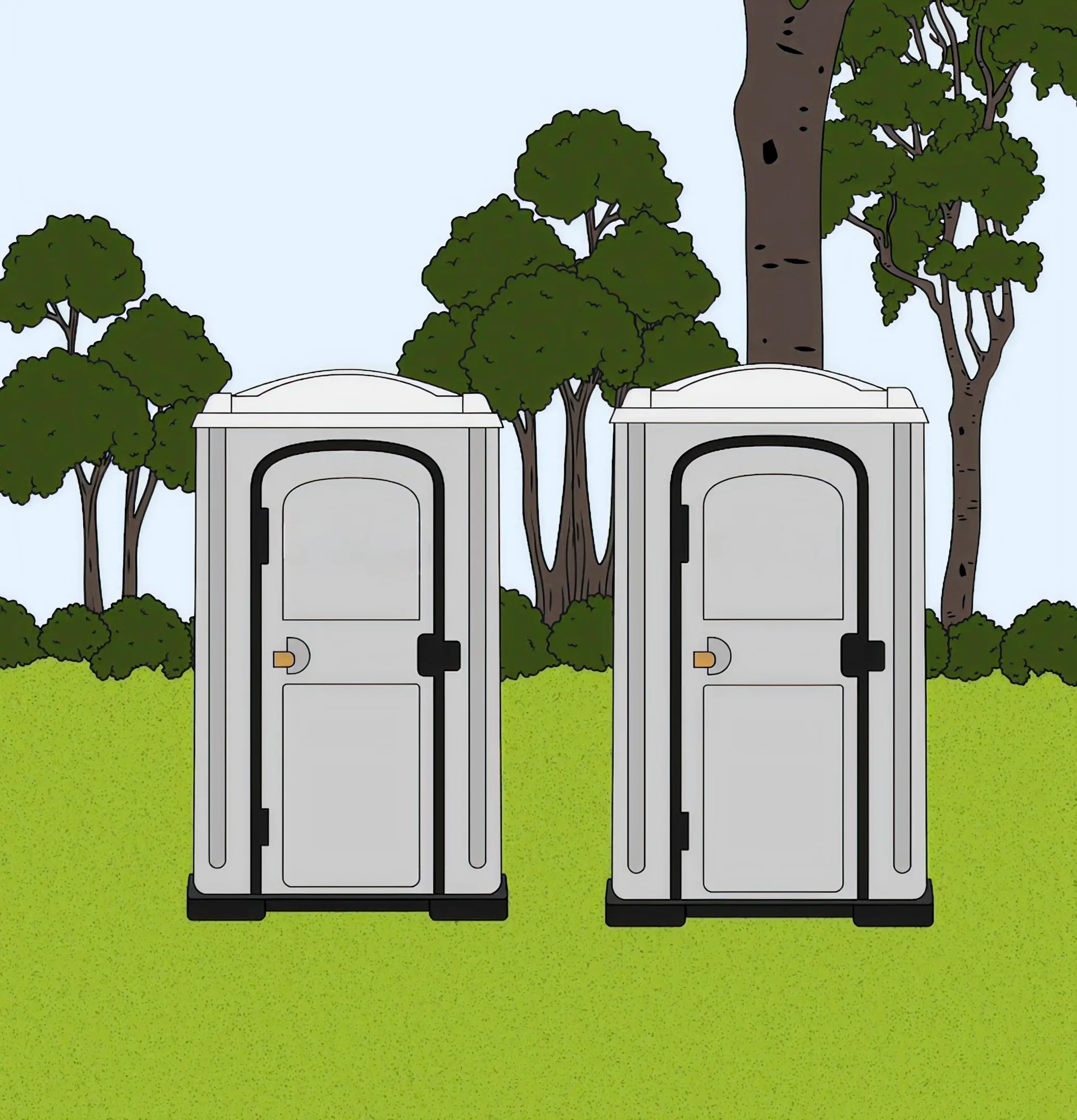
The Standard Porta Potty is the Buckeye workhorse and what most subdivision orders consist of.
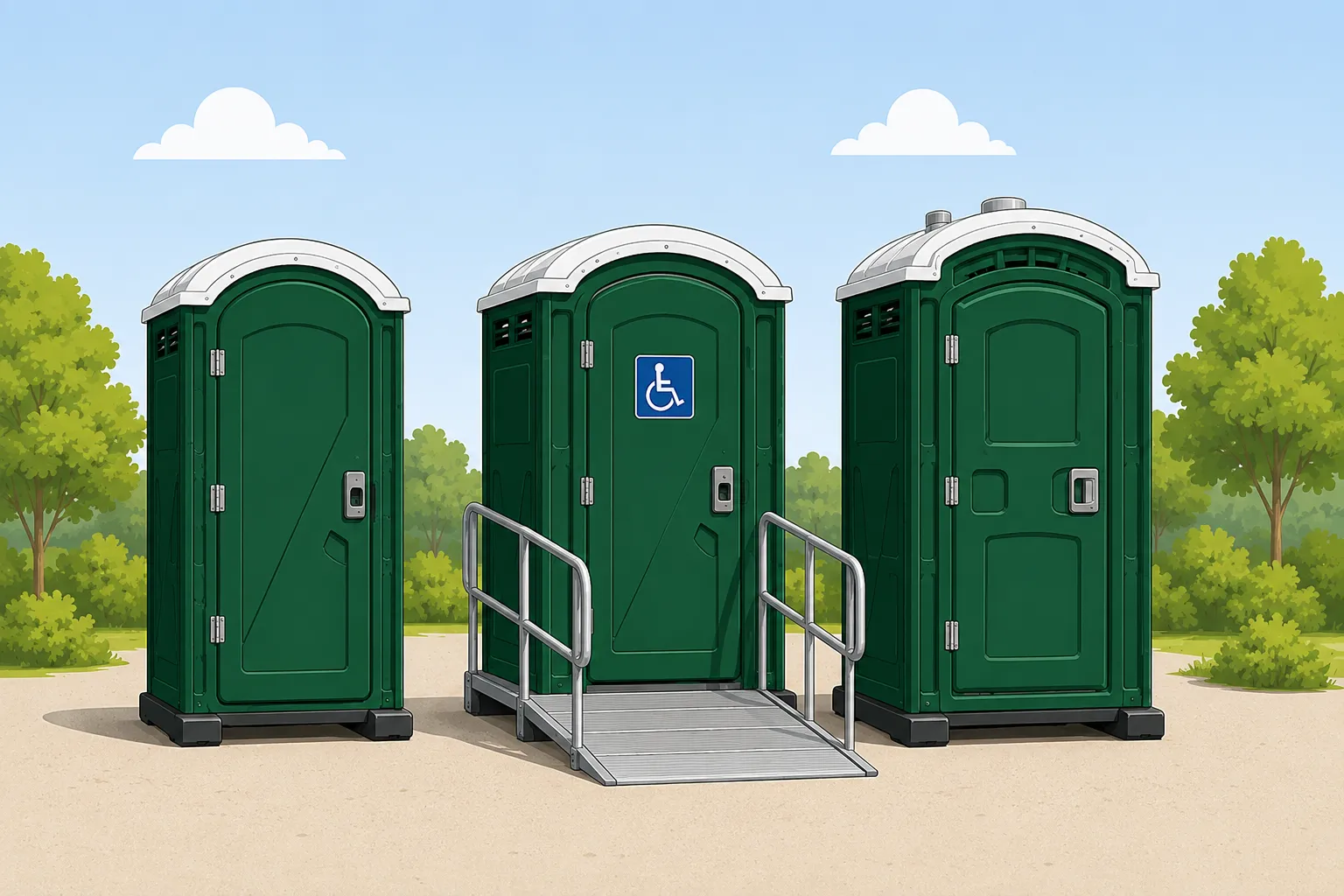
The ADA-Compliant Porta Potty gives a level entry, grab bars and turning room. Include one at any public event, and on a job site where it is needed.
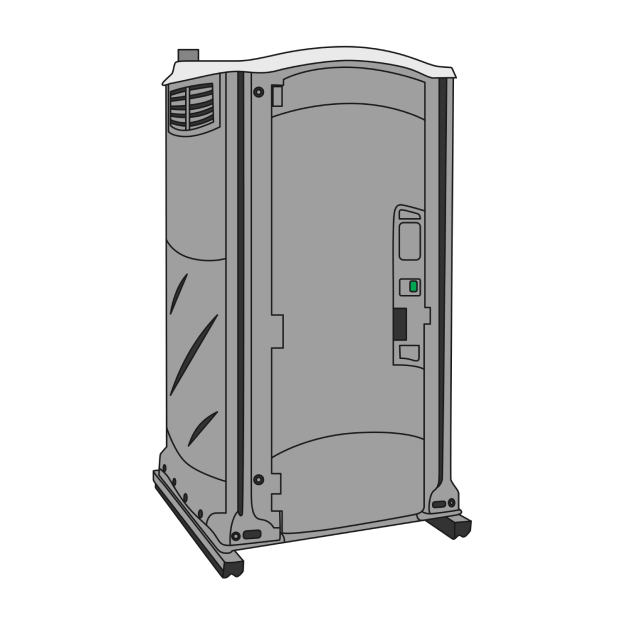
The Deluxe Flushing Porta Potty adds a flush and a rinse, and suits a wedding or a guest-facing function at one of the city's park venues.
The Deluxe Porta Potty with Sink carries handwashing inside, which is handy where there is no water supply nearby.
The Solar Porta Potty lights itself. On a Buckeye construction site with early summer starts and no temporary power, that is a practical choice rather than a luxury.
Handwashing Stations sit beside the units, usually one per ten toilets.
The Restroom Trailer suits a long site office or a multi-day community event. Look through the full porta potty options and ask your account manager to price two configurations.
On private property with the owner's agreement, no city permit is normally needed for the unit.
Buckeye's street rules are the most formally organized in this part of the Valley, and they work in your favor once you understand them. The city bars anyone from obstructing, encroaching or placing any encroachment on, over or under any public place, right-of-way or other public surface for any purpose whatsoever, without first obtaining an encroachment permit. That wording plainly reaches a unit set down in the right-of-way, so the route is not in doubt.
What is distinctive is that Buckeye then sorts encroachments into eight numbered permit classes, and the department decides which one applies. The relevant one for us is the Class 1 Minor Encroachment Permit, which may be issued for temporary, short term, small or inconsequential encroachments. The examples the code gives are public telephones, news racks, placing temporary traffic barricades in the street, and placing merchandise on the sidewalk for a temporary sale. Elsewhere in the same class the code expressly accommodates a homeowner painting within the right-of-way and a roadside memorial, which shows the class really does reach small everyday objects and not just commercial fixtures.
One sentence decides how you should handle it. The code says the determination by the department about whether a minor encroachment is appropriate shall be final. There is no appeal named. So in Buckeye the practical rule is simple: ask the department first, in writing, and build your layout around the answer you get rather than around an assumption. Do not plan a street placement on the basis that a restroom looks like it fits the class.
Buckeye's own web host would not serve us while this was written, so the city code text is what is relied on here and the counter process should be confirmed directly. For anything sanitation related, Maricopa County Environmental Services answers on 602-506-6616 and sets it out in the Maricopa County Environmental Health Code. Your account manager will get you to the right desk.
Choose level, compacted ground with a straight truck approach. On a Buckeye construction site that usually means the stabilized pad rather than the graded dirt, because a service truck on soft fill is a stuck service truck.
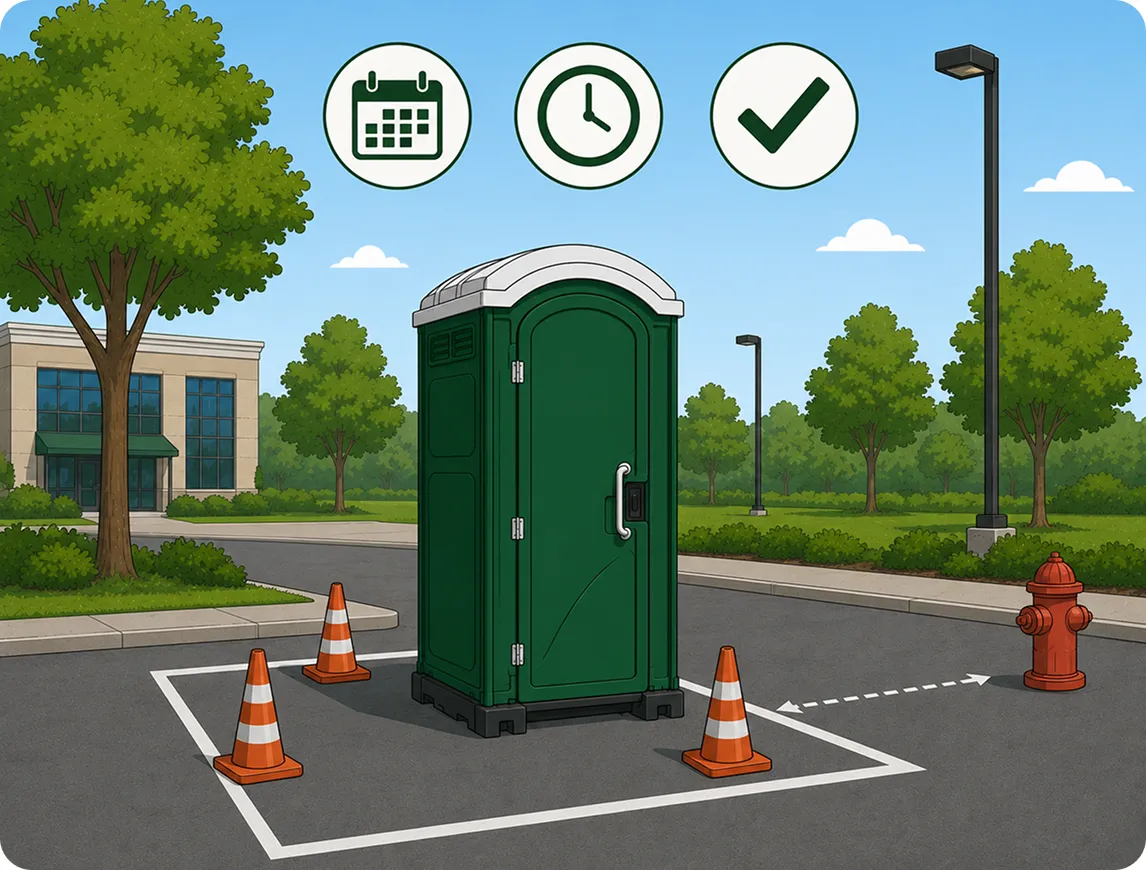
The county fixes two placement distances. A unit may not stand within 20 feet of occupied premises, nor within 10 feet of any public thoroughfare or sidewalk, unless the county authorizes it. On a wide subdivision lot that is easy. On a finished street frontage with houses already occupied, it is the constraint that decides where the unit goes, so check it at the phase-planning stage.
The county also requires units to be placed so servicing equipment has unobstructed access to remove the waste. On a live build that means keeping the unit out of the materials laydown area and away from the stockpile, because a unit that gets fenced in by the next delivery cannot be pumped.
Everything is pumped out and carried away, with nothing discharged on the Buckeye site itself. Maricopa County requires the tank contents to be removed by a vehicle it has permitted for non-hazardous liquid waste collection and transport, with the county-assigned number carried on the cab doors and the rear of the tank in letters at least three inches high. The approved destination is set when the permit is issued and cannot be changed without county approval. Arizona's environmental quality department licenses septage haulers separately, and its license names a fixed or transportable chemical toilet in terms. That makes your supplier's permit status part of your own compliance record, and your account manager can hand you those details for the project file.
Summer servicing deserves planning rather than reaction. The county standard is that tanks be emptied often enough to prevent overflow and insanitary conditions, with chemical maintained at a level that stops odors building. Buckeye's season is long and the sun is unobstructed on most sites, so a schedule that works in March will usually need a second weekly visit by June.
To learn more about the benefits of portable toilets, check out our blog post “Benefits of Porta Potty Rentals.“
Standard units can generally be arranged within a day or two for Buckeye. Large multi-unit construction orders and anything needing a trailer want more notice, because the run out here is long.
Your account manager can confirm availability and a window on the first call.
West of Phoenix, Prime Dumpster covers the whole southwest Valley from Buckeye, including Goodyear and Avondale to the east, Surprise and El Mirage to the northeast, and Peoria and Glendale further in. Verrado, Tonopah, Tartesso, Litchfield Park and the Palo Verde corridor are all within reach of a delivery truck.
In Buckeye a standard unit is priced $199 to $349, an accessible unit $200 to $300, and a deluxe flushing unit $300 to $400. Figure $150 to $250 for a handwashing station, with restroom trailers from $1,500. Travel distance affects the final figure, so your account manager quotes your exact site.
Buckeye publishes no ratio, so Maricopa County's minimum of one toilet per 100 attending a public gathering applies, within 200 feet. For a smaller private function, start at one unit per 50 guests across four hours and add 15 to 20 percent where alcohol is served.
Maricopa County asks a Buckeye project for one sanitary toilet for each 20 people, inside 200 feet of every work area, in position before work proceeds. That is stricter than the federal table above 20 workers, so the county number is what a Buckeye crew should be sized to.
A small Buckeye crew is a weekly unit. Buckeye sites running through summer, and any large workforce, usually need two or three visits. Each Buckeye visit empties the tank, cleans the inside surfaces and restocks paper and sanitizer. Your account manager sets the visit pattern from your peak Buckeye headcount.
Normally no. A unit on private property in Buckeye with the owner's agreement needs no city permit. County setbacks still apply, including 20 feet from occupied premises, which matters once neighboring homes are occupied. A permit arises when the unit sits in the public right-of-way.
The accessible unit is the bigger cabin, entered at grade, with grab bars and turning space inside. A standard Buckeye unit comes without them. On a Buckeye site, also make sure the approach to an accessible unit is firm and level rather than loose fill.
A weekend standard unit falls within $199 to $349, usually toward the upper half for Buckeye because of the delivery run. A weekend deluxe flushing unit is $300 to $400. Your account manager prices the Buckeye dates and the site access together.
Tell us about your event or project and your zip code. If it is a phased build, send the phase dates and the peak crew size, and we can map the unit count and the servicing to your build schedule.
Your Prime Dumpster account manager handles the details, from unit count and service schedule to permit contacts and delivery timing, so you can focus on your event or project.
| Business Name: | Prime Dumpster |
| Address: | Buckeye, Arizona 85326 |
| Phone: | 602-854-4085 |
| Website: | https://primedumpster.com/ |
Find your location

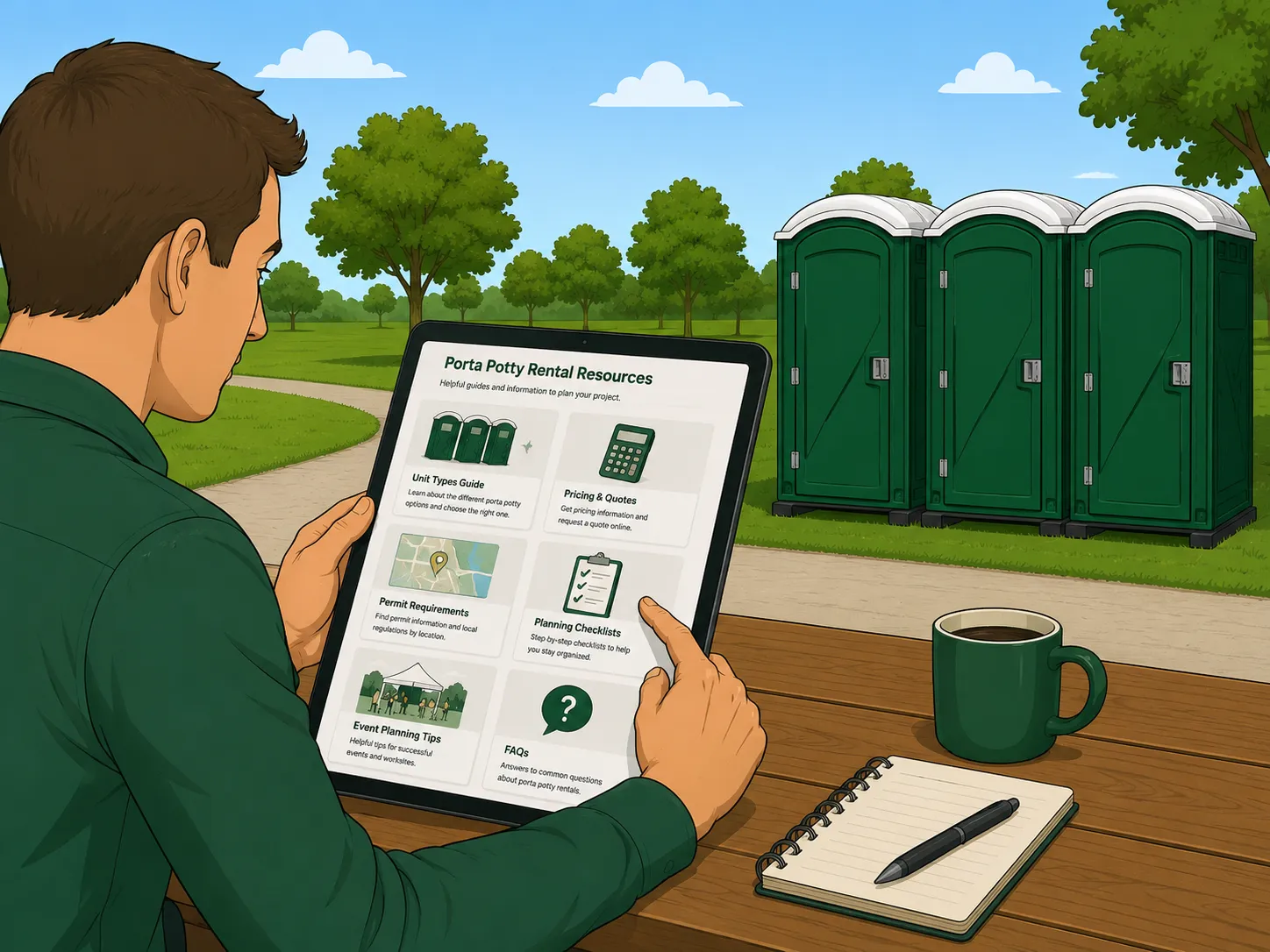
Find all porta potty rental resources in one place, from pricing and unit types to permits and planning guides.

Learn more details about porta potty rental pricing, including easy tips to save money.
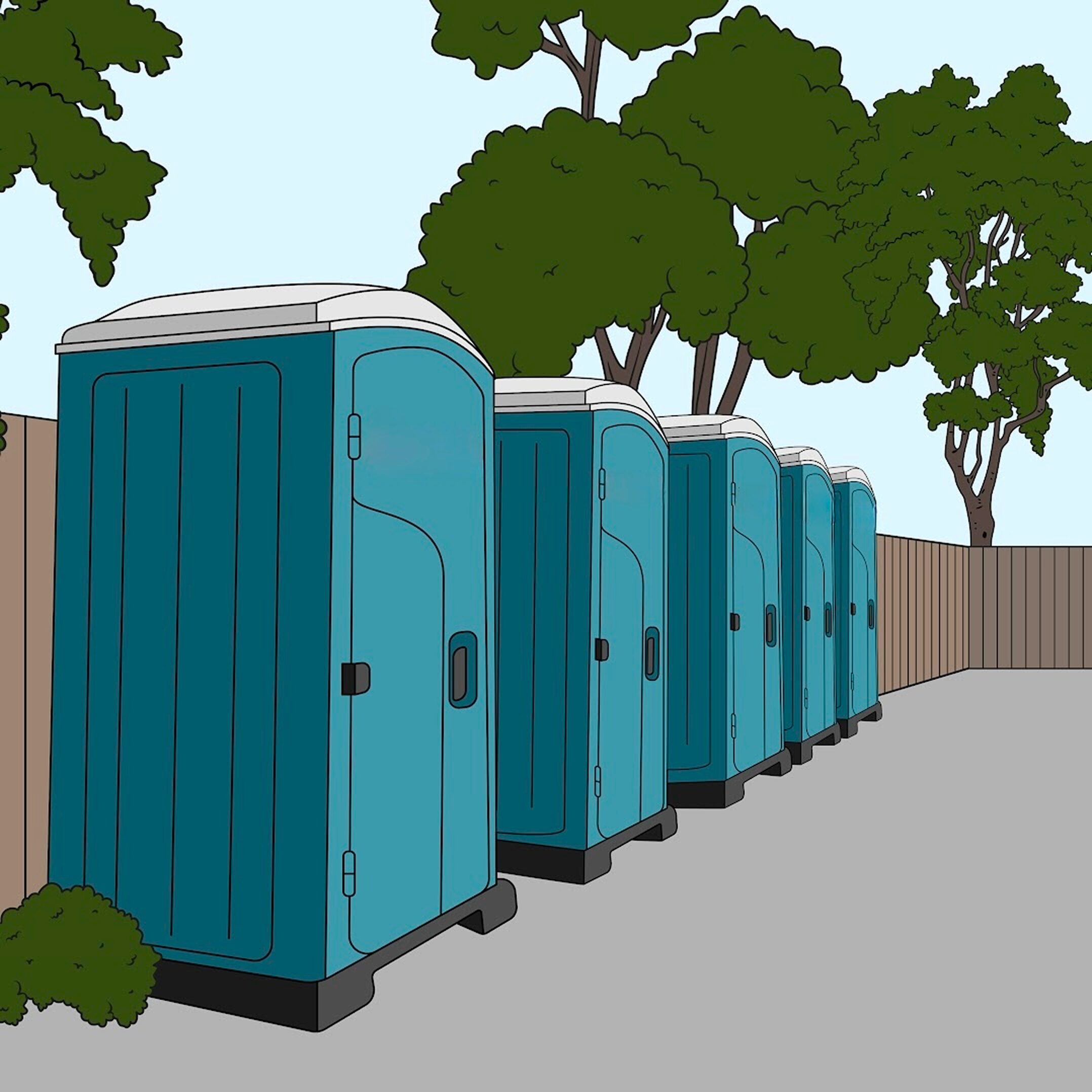
Permit requirements can vary by project and location. Learn more about porta potty permits, regulations, and planning requirements.

Give us a call today so we can help you find the right waste & sanitation solution for your project!