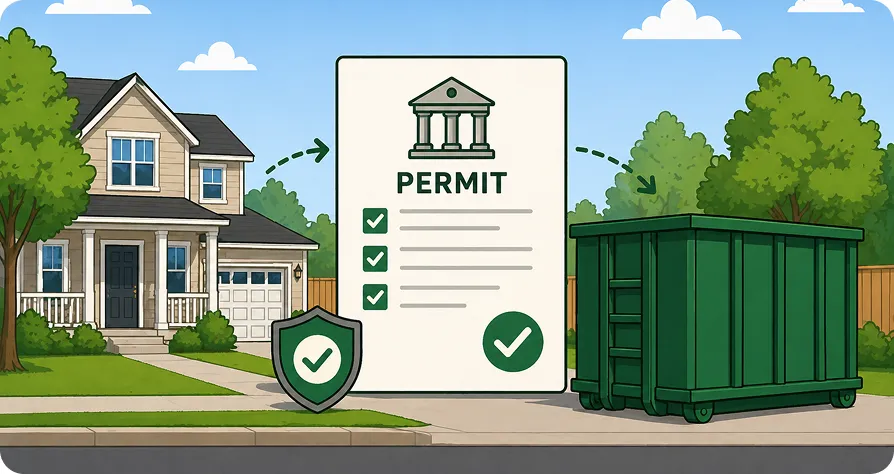
On private property, with the container on your driveway, the City's street rule does not come into play. Keep the sidewalk open and the container clear of the parkway trees.
The street is different. The City publishes its street occupancy rule, and it reads: "It shall be unlawful for any person to deposit, store or erect on a street or alley right-of-way any building materials, tools, equipment, supplies, or scaffolding" used for a building being "erected, altered, repaired or demolished" without first getting a street occupancy permit from the Engineering department.
That wording lists materials, tools, equipment and supplies. It does not name a debris container. So in Wheaton, treat a street placement for a construction job as a question for Engineering before the container arrives, and do not assume it falls outside the rule.
Where the rule applies, the City's published conditions are clear:
- Insurance first. A certificate of insurance must be filed before the permit is granted.
- A deposit. The City may use it for barricades or repairs if the permit holder does not handle them.
- No traffic hazard. No permit is issued where, in the traffic engineer's opinion, the occupancy would impair traffic or block sightlines.
- It ends with the work. Street occupancy for building purposes ends when the job is complete.
- Warning devices. Signs, barricades and lights must follow the state traffic control manual.
Applications go through the City's online permit portal, and the Building and Code Enforcement Department answers questions on 630-260-2050.
Wheaton also licenses some haulers. The City licenses commercial waste haulers that serve multi-family and commercial properties "with a centralized dumpster system," and it lists the licensed companies. That wording describes ongoing trash service, not a temporary construction container, and the City does not say whether it reaches a roll-off for a single job. Your account manager raises it with the City when a Wheaton commercial or multi-family address is involved.