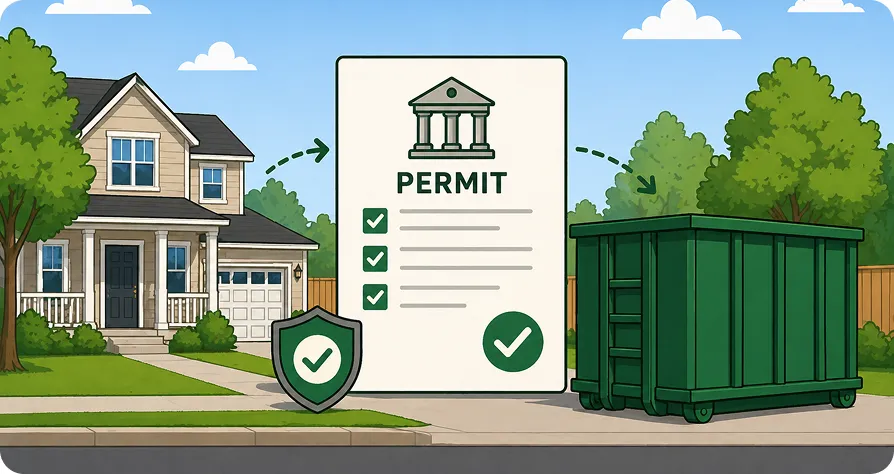
On private property, a driveway or a construction pad, you need no placement permit from Concord, and the city's own rules push you that way. A business's receptacles may not be placed within the limits of any street or other public place, while a residence's receptacles may sit in the right-of-way immediately adjacent to the premises provided they do not interfere with its use.
For anything genuinely in the right-of-way, Concord issues an encroachment permit through its Engineering Division, applied for on the city's online permit portal. The city reviews the submission, sets the permit conditions and fees, and tells the applicant what is due when the permit is ready. The Permit Center is at 1950 Parkside Drive, Building D, on 925-671-3425. Note the knock-on effect: an encroachment permit is itself one of the permits that can make a job a covered project under the city's recycling rules.
Now the part that matters most. Concord reserves unto itself the exclusive right to collect solid waste produced or found within the corporate limits, and makes it unlawful for any person to collect solid waste in the city except as its own article allows. Collection may be carried out by the city, or by a person the city has contracted with, and separately by self-haulers as allowed under state law. Anyone else needs a special written permit, and unauthorized collection is a misdemeanour.
The construction side has its own route, and it is an unusual one. On a covered project the applicant is told to use the city franchise hauler to move construction and demolition debris to certified recyclers. The applicant may instead self-haul, or direct an affiliate to haul, with no waiver required. But an applicant may only use a non-affiliated company to haul that material if the franchise hauler has granted a waiver, in writing, with a waiver number issued to the applicant. In other words the gate on a third-party container in Concord is held by the incumbent, not by the city.
A covered project is defined by value rather than by size. A residential or commercial job counts once its total cost passes a threshold set in the city's recycling article. A city-owned or city-sponsored job counts at a higher threshold. A roofing job counts above a lower value, or where half the roof area is replaced, or where five squares of material are needed. A demolition project is covered at any value at all. A performance security goes in with the permit application, and the city refunds it early if the applicant files a hauling agreement with the franchise hauler. Your account manager will tell you honestly where your project sits and what we can do at your address.